How People Marked the Day Before Household Clocks
Marking the day before the clock meant reading daylight, following task sequences, and recognizing local signals to coordinate work and gatherings.
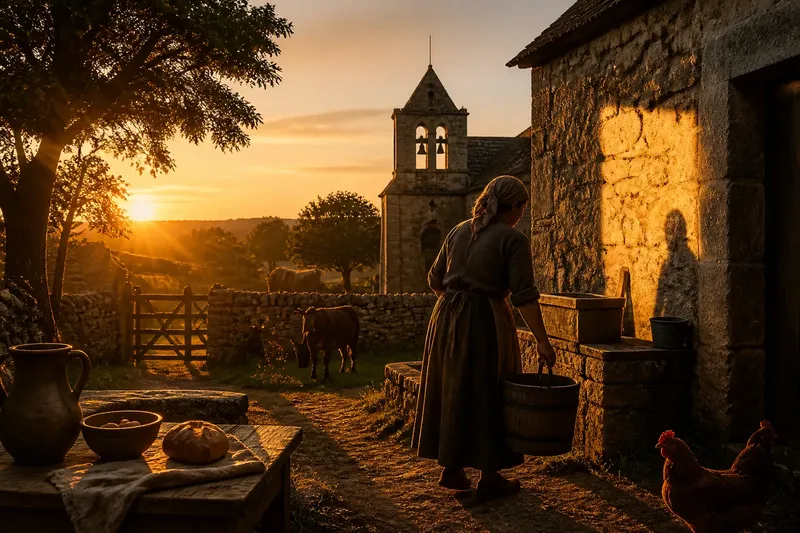
How did people know when to work, pause, or gather before a clock stood in the house? Marking the day before the clock often meant watching daylight, following familiar tasks, and recognizing signals whose meaning belonged to a particular community.
Daylight set the broad rhythm
For people working outdoors, sunrise and fading light offered clear boundaries. Dawn made paths and fields easier to see; dusk limited the time available for travel or outdoor tasks. These signs marked broad parts of the day, not an exact hour.
Season and location shaped what daylight allowed. Long summer evenings could leave time for work after a meal, while shorter winter days called for different arrangements. A shadow on a familiar wall or sunlight reaching a doorway might help residents judge the day’s progress, though such cues depended on the building and its surroundings.
Use the local landscape to understand a daylight-based custom. A hillside, tree line, or building can explain why a particular time felt recognizable to the people who lived there.
Task sequences made time observable
In a household or work setting, the order of tasks could provide a shared sequence: tend animals, prepare food, then begin another job. The sequence did not specify a fixed duration. Weather, the season, and the work itself could change how long each task took.
“After the animals are fed” names an observable event rather than an hour. That can help people coordinate around work that depends on living things or changing conditions, but it leaves room for variation in pace.
Say a household plans to carry water before beginning fieldwork. Its members agree that the next job starts once the containers are filled and brought home. If the trip takes longer than expected, the start shifts with it; the completed task remains the shared cue.
Signals coordinated particular gatherings
Signals were specific to their place and use, rather than a universal timekeeping system. For example, church bells in many European towns have been used to call people to worship, while a work bell at a particular mill could mark a shift or break. The sound’s meaning depended on local practice; a visitor might hear it without knowing what residents were expected to do.
A signal could announce that a gathering was beginning without dividing the whole day into precise units. It gave people in different locations a common prompt, while daylight and task sequences continued to guide ordinary work. Weather, terrain, and the signal’s reach affected who could hear or see it.
What can different time cues tell us?
Could a sundial tell the time before household clocks?
A sundial could indicate time from the sun’s position where it was installed, but it needed sunlight and a suitable placement. Its presence did not mean every household had access to a clock-like device.
How could people agree when to gather?
They could use a familiar signal, a shared task sequence, or an agreed point in the day, such as after a chore. Each cue worked only when the people involved understood its local meaning.
Did one cue organize everyone’s day?
No. A signal might coordinate a group, while individual households followed their own work and daylight. Different people could share a broad rhythm without keeping identical schedules.
What did clocks add to these customs?
Clocks provided a reference that people could name and consult apart from an immediate task or daylight. They did not remove the need to judge weather, work conditions, or the meaning of a local custom.
Local customs defined what counted as on time
In a community organized around shared cues, arriving “on time” could mean coming when a customary signal sounded, after a task was complete, or while enough daylight remained. These expectations addressed practical needs through signs people could observe together.
Several ways of marking the day could operate at once. A household might plan routine work around daylight, then respond to a signal for a communal event. A clock later offered another reference, but it could not tell someone whether a field was ready or whether fading light made a path difficult to use.
To interpret a seasonal custom, ask what makes its timing recognizable: daylight, a task, a local signal, or a combination. That clue can show how the practice fits the setting and why its timing may remain flexible today.